

Courthouse shock: Google 0, Publishing 1
Is this an AI headline, or reality? Publishers suing Google for ad market ripoffs have been handed a win after a US federal court ruling looked to clear the way straight to damages and remedies.
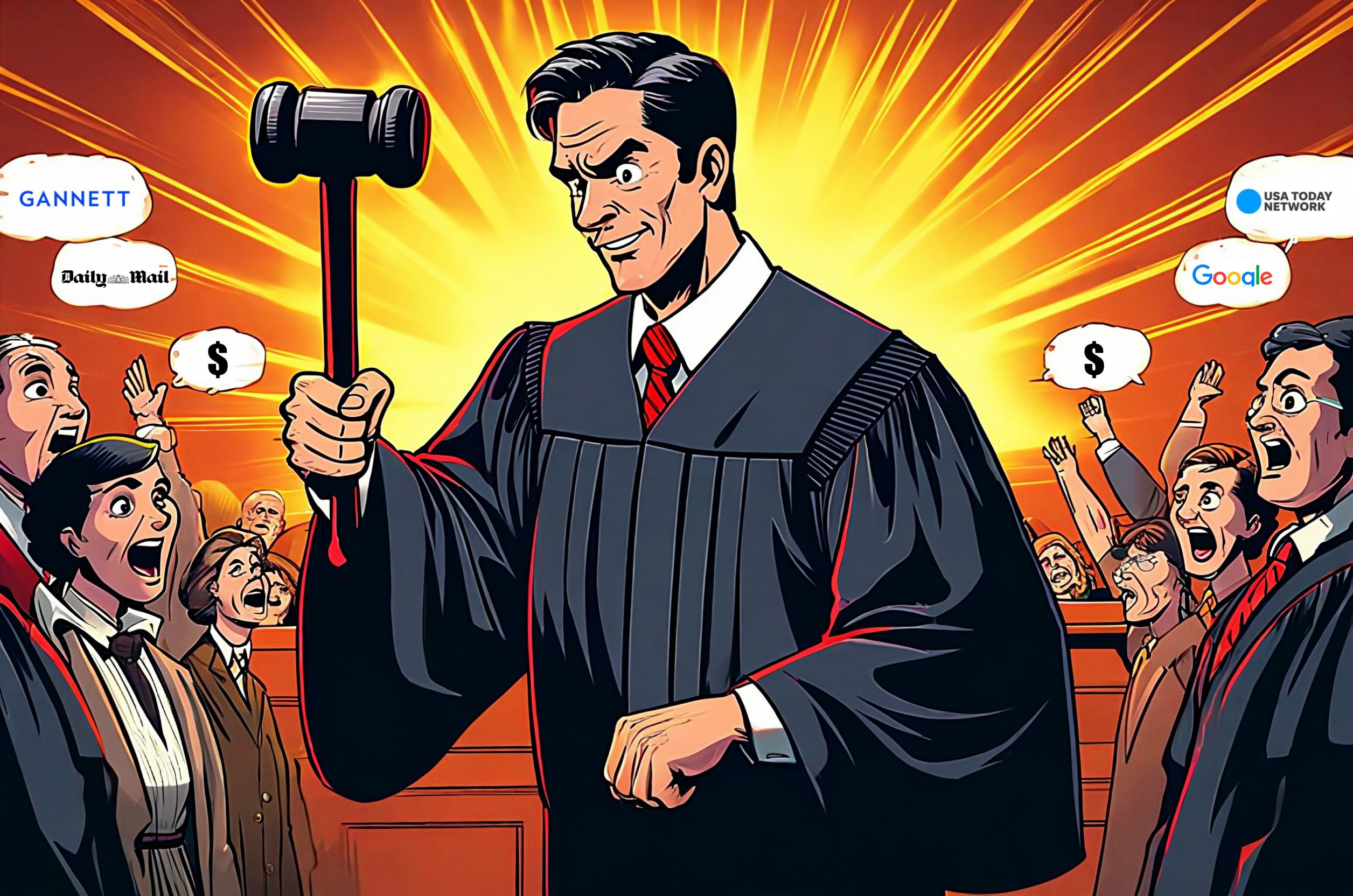
Sometimes, being clever can backfire.
Last year, during the main phase of the Google Ad Tech Monopoly Trial, and no doubt wary of how a non-expert jury of real people might interpret the company’s conduct in the advertising market, Google manoeuvred to ensure proceedings would be heard and judged by just one person: Northern Virginia under US District Court Judge Leonie Brinkema.
What looked smart back in 2024, and was facilitated for the paltry sum of $2.3m, now looks very unsmart. In fact, as far as backfires go, this is a Chernobyl graphite-tipped control-rod level backfire.
How so? This week, during a separate New York trial brought by major publishers against Google for ad market abuse, its presiding federal judge decreed that the findings and conclusions in the Brinkema adtech antitrust trial - that Google did indeed run an illegal monopoly in the ad industry - stand as established fact.
Which basically implies, there’s no trial to be had - we go straight to damages and remedies.
With great irony, experts pointed out that by side-stepping a jury trial and pinning their hopes on Brinkema’s opinion, a key legal lever which could have been relied upon to dispute the publisher suit this week does not exist.
If a jury had sat in judgement at the Brinkema adtech trial, there would have been wiggle room in the meaning of the jury’s finding. But, as US District Court Judge P. Kevin Castel found this week, “Judge Brinkema’s findings of fact and conclusions of law are precise and concise.”
Delicious justice isn’t it?
Publishers together strong
For publishers, and to some degree countless other businesses enmeshed with the Google ad ecosystem, this looks like a gigantic victory of which we will hear much more as the implications become clearer. Even if others do not go to court, the ruling can give powerful leverage to our industry as the threat of action now has far more implied weight behind it.
A moment too to celebrate those behind the action, with a shout out to Gannett, the Daily Mail, Inform, and a group of smaller unnamed publishers waiting in the wings as looming litigants.
I think it’s important to highlight it being publishers themselves which gained this massive win in New York. The tech industry has picked us off piecemeal so easily in the past decades, relying on a lack of unity and individual deals to keep the choir out of tune. A legal victory gained by the combined legal forces of just a few working together is of note, as is “a proposed class of smaller publishers” being included in their case: there will be a trickle down effect.
The complaint against Google was filed in 2023 “for monopolization of advertising technology markets and deceptive commercial practices”, with the motivation for publishers being “in 2022, Google made upwards of $30 billion in revenue from the sale of ad space on publishers’ websites which was six times the digital advertising revenue of all US news publications, combined.”
It’s never not staggering to reflect how this situation was allowed to arise, and every time I read such figures stating the cash chasm between us and them, and reflect on the damage done to our industry, I do get a little mad. Yet now, and it’s a big yet, maybe the biggest yet yet, we have the chance to not just get mad - but to get even.
The forms payback will take is not at all certain - yet - but it seems certain it will involve Google transferring some of their considerable pile of ill-gotten gains to those they earned the gains from.
Quite what sums and remedies will be involved is again an unknown, but I’ll be looking for the word “punitive” to feature in there when further rulings start to be made. Given the current situation with publishers and Google’s AI search intentions, any goodwill between us and them is not so much AWOL as it is taking a long self-catering vacation in Hell.
To those fearing this ruling only applies to the US, they may be technically correct - but the effect may spread far beyond. As trial devotee Jason Kint observed in his excellent thread on the New York ruling, Judge Castel “fully adopted Brinkema’s worldwide market definition for ad servers and ad exchanges. Google’s dominance - over 90% share in ad serving - is legally established”.
That gives other jurisdictions a water-tight data point from which to proceed in their own actions, and more importantly, it provides powerful political cover to go after Google for those who need the excuse.
In all the time this column has existed, our primary contention has been that there has been zero chance for publishers to get their just rewards from the advertising they attract while Google controlled so much of that advertising market, and controlled it in self-protecting ways.
The thought that this may no longer be the case and redress is available is actually hard to absorb. But absorb it we will, and with consequences.

Speed up the pace of product development and new launches with Glide Go, a pre-configured deployment of Glide CMS paired with a full-featured website hosted and managed by Glide.
Shift your focus to content and revenue while we manage the rest.
Request a demo to see Glide Go in action.
AI hits newsrooms, but audiences don’t like it
While newsrooms are embracing AI, their audiences don’t like the tech in newsrooms. Occasional Content Aware-r Richard Fairbairn writes for INMA about AI transparency, newsroom disclosures, and how media and publishers walk a tightrope between innovation and trust.
Read
Status update: many many legals
Copyright vs AI cases are popping up like rugged flowers against the content desertification being ushered in by AI thievery. Such cases now number at least 57 in the US alone. Here’s the latest update on actions, with an interactive map and some pleasingly salty commentary.
Read
WordPress’s battle of the brands
Shots continue to be fired in WordPressland, as “owners” Automattic accuses WP Engine of hijacking WordPress branding and ghosting its open-source duties. The countersuit alleges trademark tweaks, broken promises, and a muddy narrative behind WP Engine’s claims. While countless site owners and admins scratch their heads, commentators wonder if in the world of Open Source, individuals still have too much sway.
Read
Unconvinced by conversions
ChatGPT backers say the AI tool is manna from heaven for e-commerce sites - but data disagrees. A year of first-party data from 973 e-commerce websites was picked apart, comparing ChatGPT-sourced conversions against other lead sources, and the findings bring a chilled blast of fact against p-AI-in-the-sky promises.
Read
Atlas hacked
OpenAI browser Atlas is barely out of the blocks and already has been shown to have a major security flaw. Hackers can get the browser to redirect users to phishing sites by means of malicious URLs and fake sidebars. Other AI-heavy browsers, Perplexity Comet and Opera Neon, were also vulnerable - researchers at Brave managed to trick Comet by just putting text into images, such a screenshot. You may not like Chrome or Firefox or the untrendy options, but they tend to realise this sort of stuff is bread and butter to avoid. Boring question: what are your org’s browser policies and which are your teams using?
Read
ACCC targets Microsoft
Microsoft finds itself in trouble Down Under. The Australian Competition and Consumer Commission (ACCC) alleges the tech giant bamboozled 2.7 million Aussies into paying more for Microsoft 365 by blithely bundling AI assistant Copilot into the service - along with a price rise - all while making sure the cheaper option is nowhere to be found until customers try to cancel.
Read
Discover’s fake news frenzy
Google Discover is always a roller-coaster, but lately it’s been driving chaos as well as traffic. Spam news sites cracked how to populate Discover feed than driving traffic, with a flurry of fake stories about pensions and driving licences being seen by millions and outrunning real news.
Read
More turbulence in Google-land
Although Discover can bring big traffic wins, AI Summaries are showing cracks in the form of unpredictability and misinformation and making good SEO more important than ever. SEO guru Steve Wilson-Beales shares his thoughts on how to navigate the waters.
Read
Click, dwell, repeat
Scouring through all the information in the Google leak earlier this year, Harry Clarkson-Bennett has a look at how Discover actually works, and how it picks content, scores sites on trust, relevance, and freshness, and insight into the importance of rapid engagement with your content.
Read
OpenAI’s big reset
OpenAI, the non-profit, is a step closer to being a for-profit, where it will be assumedly be obliged to ramp up the price of its services and - probably - try and pay even less than it does now for content (lol).
Read
BrightonSEO’s AI reality check
BrightonSEO 2025 confirmed what we have all been sensing, AI isn’t just playing on the edges, it is rewriting the rules. Is the future going to be smarter, faster, and more integrated? Surely, but only if you’re willing to adapt. Sam Monaghan knows more.
Read
Grok and troll
Ever thought Wikipedia was just too complicated to look at and had way too many facts? You’re in luck! Grokipedia, an AI-disgorged Wikipedia knock-off in ChatGPT dark mode, is Elon Musk’s latest cut-and-waste copy of a pre-existing idea. With its black hole logo perhaps alluding to the consumption and destruction of all information, it so far seems comprised of burgled Wikipedia content sent to an AI re-education camp and forced to wear approved overalls. We suggest all other Wiki site owners keep alert for their sites being assimilated.
Read