

Does Google own its AI Overviews answers?
A court ruling in Germany has held Google liable for erroneous answers provided by AI Overviews - is this a precedent that changes the game?
What is meant by transformative in a commercial sense? Your pigs into my hams certainly means I’d be responsible for the quality or not of the ham. “It’s not bad ham madam, it’s bad pigs” doesn’t cut the mustard, does it?
How about the tin used to create plasma in the delicate process of producing 3nm chips in a ultraviolet photolithography machine? If Tim’s Tin Company doesn’t supply the requisite grade of tin, and the photolithography machine ends up producing silicon lego bricks, whose fault is that? The people running the machine and not checking their tin, obviously.
Well, what of LLMs? Currently, the consensus is that they operate at around 90 per cent accuracy. One in ten of the results they return are flawed to one degree or another. This is something users are expected to be aware of (they often aren’t) and must take in account when using one.
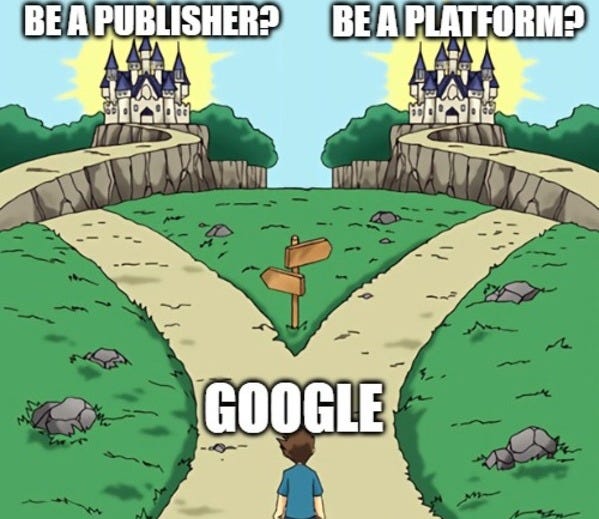
Over to Germany, specifically a court in Munich, which in the past few weeks has ruled that Google is liable for false claims in the answers its LLM returns and could signal an end to Google’s traditional shield of “we’re a platform not a publisher”.
The case that saw the court bring legal scrutiny to bear on the matter actually involved two actual publishers, to add insult to injury. Answers provided by Google’s AI Overviews had falsely linked the publishers to scams and dubious business practices such as subscription traps, which is obviously a commercial death sentence for the online presence of any business.
The Regional Court of Munich found that Google could not employ a “fair use” defence in the case. In Germany, as in most jurisdictions, search engines are not liable for the results they produce, yet the court ruled that AI Overviews are something quite different to that - they produce “independent, new, and substantive statements” in Google’s own words, so that Google is ultimately responsible for what is produced by them. The court identified the false claims as “the defendant’s own statements”.
In other words, they can’t blame the pigs.
Importantly, the Munich court ruled that the links displayed by Google in this case did not support the claims made by AI Overviews. That is to say, if the process of verification that an LLM search user is expected to make by checking the sources against the answer was undertaken, then the links did not support the provided answer - an AI “hallucination” as they have been called. It’s thought that something like one per cent of users actually check sources. The advertised and constantly promoted omniscience of such systems sits uneasily with their actual accuracy, but you can’t blame people for believing the hype.
We need to reiterate our general position on AI here, lest we be seen as technological naysayers. AI systems clearly have great utility and potential. When used in a manner that allows for their performance parameters, they can be a useful and flexible tool. It’s not a question of being for or against them, rather one of judging on merits.
Google plans to appeal the ruling. “This case focuses on specific and narrow errors, not the foundational way AI Overviews displays web content. We disagree with the ruling and plan to appeal,” a Google spokesperson told Reuters.
There’s an important fork in logic here, admittedly in different legal areas. One is that content produced by LLMs is “transformative”, meaning it is so differentiated from the content used in training the systems that it is a thing in its own right. This is obviously an argument that has been deployed in LLM copyright disputes.
This position seems to be contrary to what Google would like the courts to think in the above case, where the answer is not owned by them and they are not liable for such erroneous results.
The legal framework regarding such technology is still being constructed, in fits and starts. It is to be hoped that the rigorous logic employed in the Munich case becomes a feature of that process.
After two decades of having their cake and eating it, and our cake too, such changes may mean Google has to start deciding which it wants to be, publisher or platform. It can’t be both.

From inside Glide
Anonymous traffic vs addressable audience
Most publishers run a CMS for content and an ad stack for revenue, without anything to connect those two. Without that shared identity layer, ad teams work from fragments, editorial has no idea who's reading what, and sales teams go into conversations with nothing better than a pageview number. Authenticated first-party audiences consistently command 2-3x higher CPMs over anonymous inventory, with the gap widening as third-party cookies disappear. The fix? An identity layer that ties registration, interactions, subscriptions, and consent to a single user profile every downstream system can use. Glide Nexa gives publishers that audience layer and plugs into any CMS, but on Glide the plumbing is already done. One reader, one profile, every system pulling from the same source.
Read
Publishing & Media
News without the newsroom visit
According to the Reuters Digital News Report, 10% of people globally now use AI chatbots for their weekly news, up from 7% last year. The growth is not concentrated in the Western markets - where it has mostly flatlined - but in Asia, Africa, as well as Latin America and Southern Europe. It's not just asking for headlines: 42% ask follow up questions, a third use chatbots to summarise stories or evaluate whether a source is trustworthy. Only 4% ever click through to the actual publisher. Trust plays a bigger role here than with social media: using a chatbot requires asking a question rather than stumbling across news in a feed, so people who don't trust it simply don't use it. For now only 1% name a chatbot as their primary news source, but the growth suggests it's moving beyond early adopters.
Read
Trusted by whose definition?
The UK government wants social media platforms to make "trusted" news sources more prominent in their feeds and social results. A Green Paper names the BBC, ITV, Channel 4, among other public service media as candidates, claiming that 75% of 16-24 year olds get their news from social media, where the algorithm goes for engagement over accuracy. Index on Censorship has responded bluntly, asking who decides which media source is trustworthy?
Read
Buy, replace, monetise
Three sports news sites - She Kicks, Football Blog, and Sportscasting - have been bought by a new owner that has utilised AI-generated content, producing articles containing incorrect quotes, wrong scores, and players who don't exist at the clubs described, all interweaved with gambling content, according to UK Press Gazette.
Read
Reddit turns conversations into ad inventory
Reddit is launching new ad products that are built around "community intelligence", the collective expertise sitting in 25 billion posts and comments. The headline format is Shopping List Ads, which will surface products alongside conversations where users are already comparing options and seeking advice from each other. They are also introducing Redditor Highlights, which will allow brands to showcase positive user posts about their products directly in ad units. The pitch to advertisers is more or less simple: even with AI answer engines, people still care about recommendations from actual humans, and Reddit is the place where a lot of that happens.
Read
The ID scan no one asked for
Not everyone is cheering for the UK's under-16 social media ban, and one counter argument has gained traction: age verification could require uploading government ID and facial scans, handing the platforms even more data than they had before. Outsourcing to third-party companies isn't an option either, and on top of it all smaller, privacy-focused platforms get priced out because ID checks are expensive to run, while the likes of Meta and TikTok already comply with content restrictions worldwide to stay in governments' good books. The counter case is that the real target should be the ad-funded surveillance model itself, not building a web where everyone IDs themselves to participate.
Read
The uniqueness score behind the curtain
A Google patent by the name of "Contextual estimation of link information gain" reveals that the company scores documents based on what new information they offer a user beyond what they've already seen. So basically, the information gain measure by how much uncertainty is reduced after observing the data. In SEO terms, content that simply restates what's already ranking means nothing, while content that elevates understanding gets rewarded. The bar isn't that low, it's not just about being different, it's about answering the question more effectively than everyone else. Harry Clarkson-Bennett breaks it down.
Read
Discover just got a lot more crowded
Google Discover in the UK has quietly introduced new changes. Social content from YouTube and X? It now fills nearly a quarter of the feed. AI Overviews? They appeared out of nowhere and now shows on roughly a third of the cards. Publishers who are covering the same stories are now being bundled into combined cards regardless of the angle, with over 30 spotted on a single one. As AIOs only seem to appear within these combined cards (so far), if your content isn't differentiated enough to stand on its own, it'll most likely be summarised and grouped. We're still waiting on a formal announcement.
Read
Big Tech
Verify or lose Claude
Anthropic's updated policy, which is taking effect July 8th, says that the company may ask Claude users to upload their government-issued ID, a selfie, and face geometry data in order to verify their identity "in certain circumstances". The company claims it's for flagged accounts only and unrelated to the Fable/Mythos shutdown. What makes the timing a bit odd is the fact that this change came at a moment when Anthropic is under pressure from the US Government, which has designated the company as a "supply chain risk" and forced its latest model offline. The identity-checking will be done by Persona, backed by Peter Thiel's Founders Fund, from which Discord has distanced itself after user backlash.
Read
Ohio breaks the winning streak
NetChoice has been batting away child social media laws across the US, winning cases in Arkansas, Louisiana, and Georgia. Now Ohio has ended their streak, after a Sixth Circuit court ruled 2-1 that requiring parental consent for under-16s is constitutional, and the law should be enforced. While NetChoice says it goes against "clear national consensus" and plans to keep fighting, with the UK, Australia, and now a US federal court backing similar measures, that consensus seems less and less clear.
Read
Dark patterns win (again)
The EU proposed replacing cookie banners with an automatic signal for your tracking preferences, and Google's response to that was a paper arguing all online advertising would collapse without them. The Commission pointed out consent would still work per-website, so users could say yes to quality media and no to Google. However, it didn't really matter as Germany, France, and Poland killed the proposal anyway. So the cookie banner stays, generating millions of annoying clicks per year while the tracking industry achieves 90% consent rates through dark patterns that only a few people would actually choose voluntarily. noyb has more details.
Read
Meta's get-out-of-jail card
Meta is aiming at KOSA in the US, the Kids Online Safety Act, trying to change the language so that tech companies become immune to state lawsuits related to minors' safety or privacy online. While Meta calls it "uniform national standards", legal advocates call it "clear-cut immunity against every parent, every school district" which is seeking to hold platforms accountable. The bill itself targets design features such as infinite scroll, notifications, and appearance filters that encourage compulsive use among young people. While Meta says it doesn't extinguish existing cases, if these changes go through they could override state laws and reshape thousands of ongoing lawsuits.
Read
Where is your data sleeping?
A new survey of 3,000 people across the UK, France, and Germany showed that half would actively avoid businesses that store their data with US providers, as four out of five now factor European technology into buying decisions. The US Cloud Act plays a big role in these concerns, as it allows American law enforcement to demand data from US companies regardless of where the servers physically sit. And it's not just talk, the Dutch blocked a US firm from acquiring a Dutch cloud company that underpins citizen authentication. While Proton, the company who commissioned the research, has a horse in the race as a Swiss privacy provider, the trend is seen among ordinary customers as well as the usual regulators and campaigners.
Read
AI & Copyright
An opt-in, but for your face
Cate Blanchett has presented a free website to the European Parliament, called The Human Consent Registry, with the aim of protecting personal identities in the age of AI. It works almost like a traffic light: allow, allow with terms, or prohibit completely. It's the first product from RSL Media, a nonprofit that Blanchett co-founded with backing from a long roster of Hollywood names. The registry cannot compel anyone to honour it yet, but the premise itself is giving AI developers a single machine-readable place to check before they snatch someone's identity. Whether the tech overlords decide to look at it, now that's a different story.
Read
The contradiction... In copyright cases, Google argues LLM outputs are 'transformative,' a new thing not derivable from its sources. In liability cases, it wants those same outputs treated as neutral platform results it can't own.