

Is 2026 a transformative year for copyright?
As the LLM transformation magic fails to work on Harry Potter, are The Teenage Mutant Ninja Turtles in the vanguard of a counter-cultural copyright battle?
Undoubtedly one of the single largest issues facing publishers as we enter 2026 is that around the notion of copyright. The legal structure that had by and large allowed people and organisations to be paid and recognised for their unique work has been seriously eroded by the tech tide of LLMs, and as it stands at the start of the year, clarity on copyright remains elusive in the mists of winter.
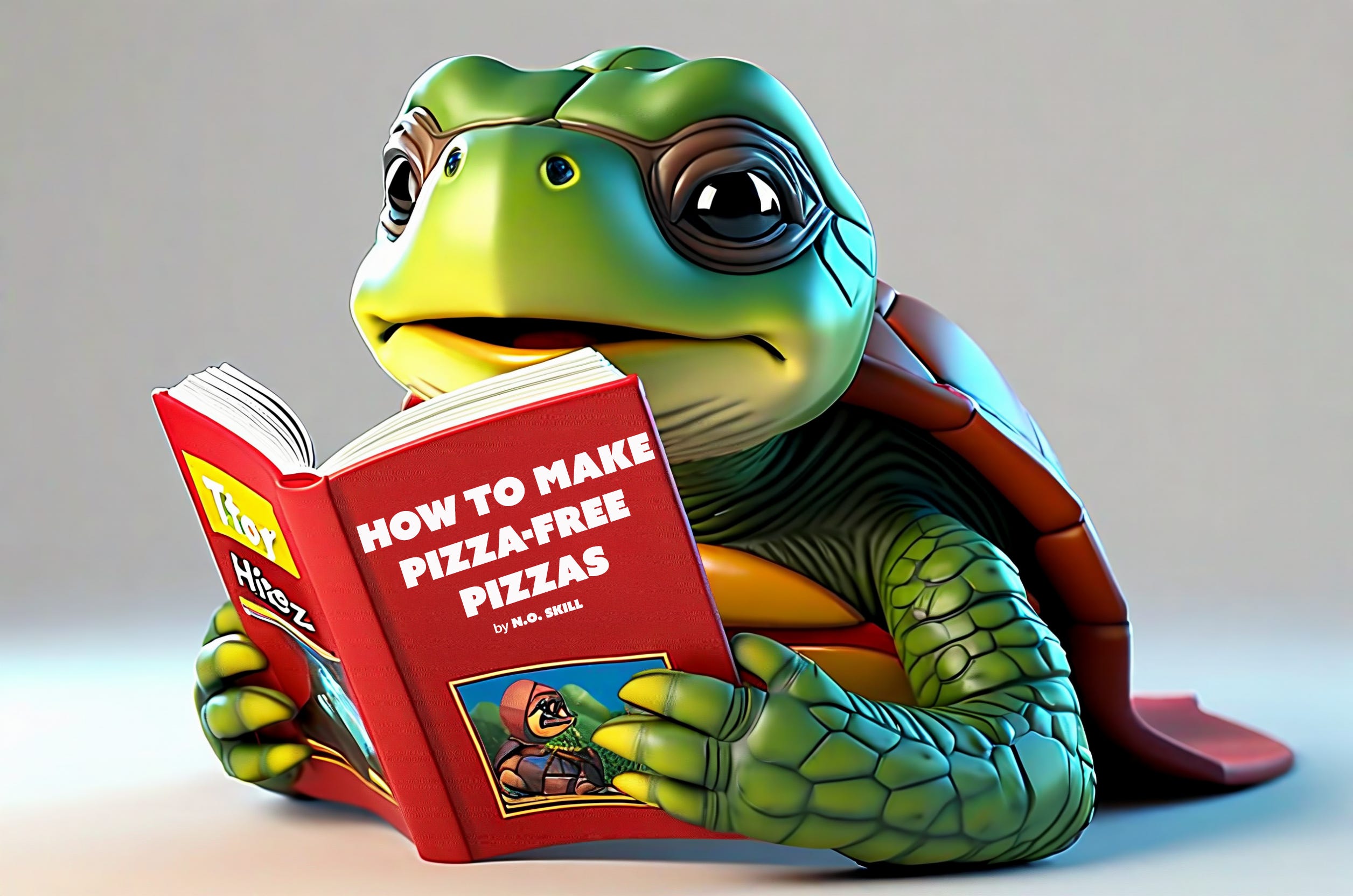
Unlikely heroes are required in such circumstances, and so who is it that we see swimming effortlessly through the slop? The Teenage Mutant Ninja Turtles. In a new short film, Teenage Mutant Ninja Turtles: Chrome Alone 2 - Lost in New Jersey, released over Christmas, the pizza-guzzling carapaced youthful martial artists tackle the malevolent AI mind behind the marketing of the Tubular Tortoise Karate Warriors, a blatant rip-off of the TMNT universe, with pizza replaced by cheeseburgers.
It’s a minor victory of course, but the existence of such a small work does show a spark of understanding from the entertainment industry that the best way to take on crap rip-offs is simply by pointing out they are crap rip-offs, and [semi spoiler alert] the AI mastermind is satisfyingly undone by the replication abilities that are the core of its existence. In mockery, there is much truth.
More substantively, this week has seen new research published from Stanford, in Extracting Books From Production Language Models, Ahmed Ahmed and his team have, well, extracted books from production LLM models. There’s not really a way of putting it otherwise, although the AI companies will attempt to explain it as some anomalous other. Yet it’s the case that the Stanford team were able to extract large parts of a number of sample popular books by the simple expedient of instructing the LLM to continue a short prefix from the book, and repeatedly querying to continue the text. By way of measure, Gemini 2.5 Pro reproduced 76.8 per cent of Harry Potter and the Sorcerer’s Stone. That’s not exactly the magic of transfiguration, to use Rowling’s terminology, is it?
The team defined “near-verbatim recall (nv-recall) to quantify book extraction: the proportion of long-form, near-verbatim blocks of text shared by both the book and the generation”, with Claude 3.7 Sonnet managing an impressive 95.8% of Harry Potter.
Importantly, the authors of the research make no general claim the extraction potential of all books, and don’t compare the relative ease of extraction between LLMs. Regardless, the fact still stands that such reproduction is indisputably not transformative, with “transformation” of copyrighted material being the legal fig leaf a multi-multi-billion dollar extraction industry depends on to hide its shame.
Some of you may recall similar such tests from 18 months or so ago, with LLMs also reproducing sample texts with the accuracy they are not supposed to be able to do. It seems little has changed in the intervening period, a period when we have been repeatedly told AI will soon harness the moon on a sling for us all to take swing rides, or something. Little to no improvement in respecting copyright is a more prosaic truth.
Natural language searches with natural language responses are, or are becoming, the dominant search pattern. It’s remarkable when you reflect upon the speed of progress in such systems, yet the LLM itself remains simply a method of information retrieval, and that retrieval is a function, not the end in itself. An information retrieval system is only as good as the information it is retrieving. Good information must be paid for.
There’s a wider divergence here that simply can’t be ignored. Loathe as we are to stray into politics, it does seem that we’re on the cusp of a change in relationship between Europe and the US, or at least a modification of such. With US courts seemingly accepting the notion of “transformation” thus far, European courts have not substantively done so. Tech is assuredly an arena which will pit US commercial interests against European notions of fairness and domination, and we can expect to see some moves that are grounded in politically protective responses from both sides that may not be motivated in what is best for both of them.
This year promises to be interesting. At least there will be plenty of our favourite commodity - news.

Stars, stripes, and surging UK clicks
UK and US news brands have always been friendly competitors in reaching each other's audiences across the Atlantic, but this time British publishers must be taking notes after two US brands, CNN and Forbes, have topped the UK's biggest growth news sites in most recent figures. But it is not all bleak, UK pride was upheld by Which?, who managed to post double-digit growth. As their CMS provider, we can't help but celebrate with them. Onwards and upwards!
Read
Algorithms, agendas, and the battle for trust
As journalism strides into 2026, it's still the case that AI remains our biggest question mark. Editors, media executives, and curious audiences alike are all busy discussing over what comes next and exchanging their predictions. Five big themes keep coming up, joined by a few side quests such as AI nudging the news agenda, business models scrambling as direct traffic dries up, and trust drifting from brands to recognisable individuals. Unlike our last newsletter, there are no crystal balls here, but there are plenty of signs that the next chapter of journalism is already being written. Buckle up!
Read
Trust, but verified
The Content Authenticity Initiative is heading into year six with a well-earned victory lap. A handful of idealists grew into a 6,000 member golden coalition, which is quietly wiring trust into the internet, and 2025 was the payoff year. It came after years of choosing the harder road, open standards, open source, endless collaboration, now Content Credentials are showing up in cameras, phones, enterprise workflows, as well as developer toolkits. As 2026 is rolling in, media transparency is finally shifting from something that's nice to have, to something that is expected by default. Provenance is no longer stuck in pilot mode, now it's becoming part of everyday media life.
Read
Ad transparency gets a glow-up
Programmatic advertising's trust problem might finally be going to rehab. The Trade Desk is wooing big publishers to its new OpenAds auction, with promises of fewer hidden fees and a clearer view of where their precious ad dollars really go. Others are also jumping into the waters, Magnite and AI-powered performance partner Cognitiv have joined forces, betting on smarter algorithms and a richer bidstream against the chaos of today's multi-channel ad world.
Read
Four-year AI toy timeout
California State Senator Steve Padilla wants to hit the brakes when it comes to AI in kids' toys. A proposed bill would enforce a four-year ban on chatbots aimed at children, citing safety risks and Big Tech's tendency to look at young users and see lab rats. This measure would also potentially put California on a collision course with the Trump administration's stated aim of Federal law setting the rules for AI, enacted by Executive Order. However, the order explicitly features exceptions for state laws related to the safety of minors.
Read
Fact-checkers in training
Besides reading and writing, Finland wants to make sure the kids know how to fact-check the world as well. From aged three, students are learning how to spot fake news, analyse media, and now also decode AI-generated images and videos. The schools have something called "Newspaper Week" where they are handing out ABC Books of Media Literacy instead of candy, making verifying information as normal as recess. With misinformation being everywhere and AI tools getting trickier day to day, the Finnish educators are doubling down and all agreeing that knowing what's real and what isn't is a superpower worth having.
Read
Forums over feeds
Reddit has quietly scooched in front of TikTok and claimed the UK's fourth most-visited social media crown, with Gen Z loving every single messy and human-generated minute of it. With a little help of Google, who tweaked its search algorithms and AI deals who put Reddit content front and centre, more Brits are turning to forums for things such as parenting trips, skincare hacks, and sports banter. The site that is filled with honest and unpolished advice stands in sharp contrast to AI-generated slop, and its upvotes, downvotes, and endless threads are winning right now.
Read
Google gambles, publishers win
Google's attempt to pay its way out of a jury trial didn't go as planned. In what could be seen as a bold move at the time, the tech giant handed over damages before it even went to trial, in hopes to dodge scrutiny completely. A US judge said hard pass on that, threw the plan out, and brought The Daily Mail, USA Today, and 200 other publishers even closer to victory and a potential payday. Ricky Sutton shares more details.
Read
2026 SEO toss across
Google's December 2025 Core Update has landed, and it landed like a ton of bricks. A handful of sites, such as The Times and MoneySavingExpert saw some sweet visibility boosts, but at the same time hits came hard for others such as The Guardian, Sky News, and The Telegraph. Thanks to Site Reputation penalties, not even top-tier content was spared, leaving teams scrambling for search traffic. As you can guess, Google is still king of clicks, and 2026 looks set to be a brutal and eventful game of SEO musical chairs.
Read
Are you visible or invisible?
Just like everything else, SEO also got a makeover with a little help of AI (whether we like it or not). Traditional clicks now became mostly optional, as search results are dominated by generative summaries that skim content, quote snippets, and sometimes just don't even send visitors your way. The playbook? Answer-first content, structured data, and authority signals. Search Engine Land knows more.
Read
CPB pulls the plug
The US Corporation for Public Broadcasting is officially closing the curtain, after more than half a century of funding PBS, NPR, and hundreds of public stations. As Congress has cut the purse strings, CPB's board opted for a graceful exit and made sure that as their final hoorah, they keep archives such as the American Archive of Public Broadcasting and its records safe. While leaders insist that public media isn't dead but just temporarily out of the game, CPB itself went quiet and slowly faded into history.
Read
AI logs under fire
OpenAI just lost a legal showdown. A US Judge ruled that the AI firm must hand over 20 million de-identified ChatGPT logs to news organisations who are looking for copyright infringements. OpenAI hoped to limit the search, but the judge wasn't having it. The attention now switched to the millions of chats that were thought to be deleted. Plaintiffs which are led by The New York Times are all crying foul and accusing OpenAI (and Microsoft, because of Copilot logs) of using delay tactics and selective preservation, saving the data that is helpful to them while tossing the one that isn't. Sanctions are surely on the table.
Read
HarperCollins bets on AI
HarperCollins France decided to throw out human translations for AI when it comes to the translations of their Harlequin romance novels. The publisher is banking on a machine called BrIAn, aided by a small team of freelancers, which will crank out translations cheaper and faster than humans ever could. French translators are already calling it soulless, a move that kills nuance, creativity, and jobs, while HarperCollins says it's just trying to keep prices low while also keeping the romance flowing.
Read
SEO's new frontier
It might be time to brace ourselves, as SEO in 2026 will be another round of a survival game. After the panic mode we've all been in last year, the focus now has shifted from frantic clicks to smarter workflows, redefining success, and measuring impact. Newzdash has asked 20 SEO experts on what's coming next and what to do if you want to conquer SEO in 2026.
Read
Cheers for the mention Rob.